
Dance for Better Health: The Benefits of Dance for Older Adults
By Vicky Hatch, Clinical Exercise Specialist
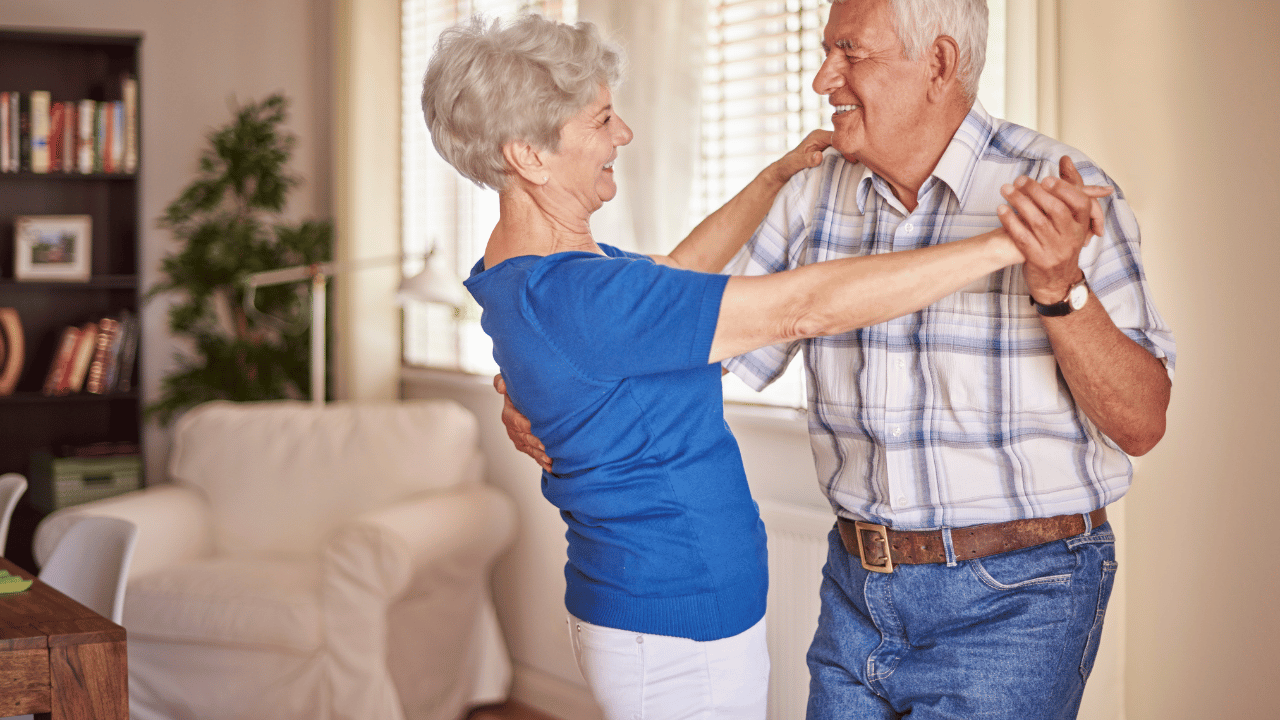
Quick answer: Research suggests dance can support balance, joint mobility, cardiorespiratory fitness and mood in middle-aged and older adults, while offering a sociable, low-cost and low-impact way to stay active. It suits a wide range of ages, abilities and health conditions, and can be adapted for seated, home-based or group settings.
Put on the right piece of music and it is amazing how quickly your toes start tapping, a shoulder begins to shake, or your hips start to sway. Dancing is one of the most enjoyable ways to move a little more, and research suggests that dance programmes may support physical function, balance and quality of life — especially in middle-aged and older adults.
And the lovely thing is, dance does not have to mean sequins, spotlights or complicated routines. It might be a friendly class, dancing with a partner, a seated session, an online video or simply moving along to a few favourite songs at home. It can be adapted to suit different ages, abilities, health conditions and confidence levels. The key is to choose something that feels safe, enjoyable and easy enough to keep coming back to.
Dance as a Social Exercise for Older Adults
Social moving and shaking
Dance can be social in all sorts of ways. Ballroom dancing gives people the chance to move with a partner, while line dancing and folk dancing create a shared group rhythm. 'Mixers', where people change partners for short dances, can help everyone meet more of the group without the pressure of long conversations.
For someone who feels a little isolated, that kind of gentle contact can really matter. A regular class can offer familiar faces, shared laughter and a reason to get out of the house, all of which may help build confidence over time.
Can Dance Improve Balance and Mobility in Older Adults?
Balanced ballroom
Even simple dance steps can give the body plenty to think about. You might shift your weight, turn, pause, start again and move in time with the music, often without noticing how much useful practice you are getting. Recent reviews suggest that some dance styles, including tango and folk dancing, may improve balance and mobility in older adults. That said, dance should not be treated as a direct replacement for a structured falls-prevention programme if one has been recommended.
Low-Impact Dance for Arthritis and Joint Pain
Low impact line dance
Many dance styles are surprisingly gentle on the joints. Line dancing, for example, can often be done at a comfortable pace, with smaller steps and fewer high-impact movements.
For people living with arthritis or joint discomfort, that gentler style may feel appealing because it is low impact, sociable and easy to pace. Earlier research on dance-based exercise for rheumatoid arthritis suggested possible benefits for pain, walking speed, mood and lower-limb function. As always, anyone with a long-term condition should choose a suitable class and ask a health professional for advice if they are unsure what is safe.
There is also encouraging newer research suggesting that dance can be comparable with other forms of exercise for cardiorespiratory fitness and quality of life, and may be especially helpful for muscle strength in some older adults.
Dance and Mental Health: Mood, Memory and Companionship
Happy tappy
Dance is not just about exercise. It can be a cheerful way to bring together movement, music, memory, rhythm and, very often, companionship. So, it makes sense that it may support mood as well as fitness. A 2024 systematic review and meta-analysis found some evidence that dance may be linked with reduced depressive symptoms in older adults.
A wider 2025 review also described dance as a promising, low-cost way to support physical, emotional, cognitive and social well-being. However, better-designed long-term studies are still needed before stronger claims can be made.
Dance for Cardiorespiratory Fitness and Heart Health
Pulse raising polka
If you like your music a little livelier, dance can be a positive way to get the heart and lungs working. Recent trial evidence suggests dance can have effects comparable with other exercise on cardiorespiratory fitness and quality of life in older adults. And perhaps the biggest advantage is this: when the music is enjoyable and the pace feels right, it is much easier to turn exercise into something you look forward to.
Dance for Joint Mobility and Everyday Movement
Supple salsa
Dance can encourage comfortable, functional movement through the major joints. Reaching, stepping, turning and changing direction may all help people keep moving in ways that feel useful for everyday life. Anyone with painful or unstable joints should keep movements gentle and avoid anything that aggravates symptoms.
How to Get Started with Dance Exercise Safely
Getting started
If you are thinking of giving dance-style exercise a try, start small and keep it fun. Pick something simple, notice how the steps feel, slow the music down if that helps and repeat movements as often as you need. And on days when a class feels too much, there is nothing wrong with putting on a favourite song and having a gentle shimmy around the room at home.
Set yourself up for dancing success with a safe space, comfortable shoes, music you love and a pace that feels right for you. It does not need to be perfect, polished or energetic to count as exercise.
The best dance exercise is the kind that leaves you feeling glad you started.
References
1. Lu, J., Abd Rahman, N. A., Wyon, M., & Shaharudin, S. (2024). The effects of dance interventions on physical function and quality of life among middle-aged and older adults: A systematic review. PLOS ONE, 19(4), e0301236.
2. Waugh, M., Youdan Jr., G., Casale, C., Balaban, R., Cross, E. S., & Merom, D. (2024). The use of dance to improve the health and wellbeing of older adults: A global scoping review of research trials. PLOS ONE.
3. Zhang, H., Gao, Y., Zhang, Y., & Ma, H. (2025). Effects of dance interventions on cognitive function, balance, mobility, and life quality in older adults: A systematic review and Bayesian network meta-analysis. Archives of Gerontology and Geriatrics, 131, 105775.
4. Prudente, T. P., Mezaiko, E., Silveira, E. A., & Nogueira, T. E. (2024). Effect of dancing interventions on depression and anxiety symptoms in older adults: A systematic review and meta-analysis. Behavioral Sciences, 14(1), 43.
5. Fonseca, I., Rueda, M., & Cabanzo, C. (2025). The effect of dance interventions on well-being dimensions in older adults: A systematic review. Frontiers in Sports and Active Living, 7.
6. Kamilova, Z., Buckley, J., Paton, B., & Loosemore, M. (2026). Effect of dance intervention on cardiorespiratory fitness and quality of life of older adults: A systematic review and meta-analysis. Frontiers in Sports and Active Living, 8.
